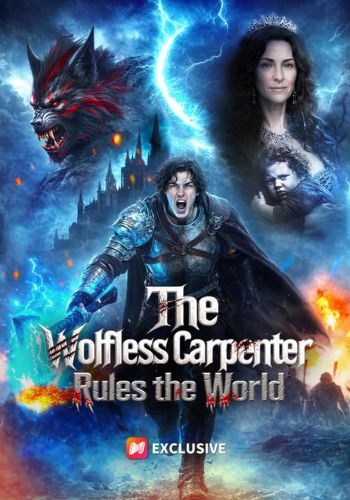

An exiled heir hides his power behind a carpenter's apron.
Advertisements
When his clan falls, only the man they dismissed can save what's left.
Raven was discarded before he ever had a chance to prove himself. Born into the Redclaw bloodline, one of the most powerful werewolf dynasties in the known world, he was cast out early, raised away from the hierarchy that should have been his inheritance. He didn't grow up with privilege or a pack at his back. He grew up with absence, and with a father's rejection as his only point of reference. By the time the story begins, Raven has returned to the Redclaw territory carrying two things: a carpenter's tools as his cover, and years of training under the Lycan King himself, tucked out of sight like a weapon wrapped in cloth.
The trigger for everything that follows is not dramatic in the way audiences might expect. Raven approaches his father seeking connection, not a fight. He wants family, not a crown. His father, confronted with the son he expelled, refuses him again. That second rejection is the engine of the entire series. It establishes something crucial: the Redclaw patriarch's authority is built entirely on the assumption that bloodline purity equals actual power. What he fails to see, and what every episode slowly reveals, is that the person he dismissed holds more real strength than anyone standing beside him.
Into that already-fractured household walks the Bloodshadow Tribe, an invading force that tears through Redclaw defenses with little resistance. The pack that should have been untouchable collapses quickly, and with it, the father's authority. Everything the patriarch claimed to protect, his territory, his title, the people under his rule, becomes vulnerable. The Bloodshadow Alpha arrives with cruelty calibrated to humiliate, demanding submission and using language about bloodline purity as a weapon. A figure who was considered powerful by everyone around him is suddenly exposed as someone who built their dominance on the wrong foundation entirely.
At the center of the emotional web is Raven's relationship with Luna, the princess whose unconscious body he carries through one of the series' most visually charged sequences. She becomes both the catalyst for his power surge and the character who complicates the story's moral geometry. She treats him better as a stranger than the people who share his blood ever did. A woman named Lorrie also extends protection to Raven without knowing who he is, which the drama uses to pose a question that cuts through the fantasy trappings: do people value you more when they have no idea what you've come from? Both relationships put pressure on the story's central theme, that identity is something you choose, not something inherited through lineage.
What separates this series from the crowded field of hidden-power werewolf dramas is the particular quality of Raven's restraint. He is not a character who hasn't discovered what he can do. He already knows, and chooses not to use it. That specific kind of discipline is harder to dramatize than ignorance, because it requires the audience to hold the knowledge of his power while watching him absorb humiliation. The lunar force magic system, built around Moon Goddess lore and expressed visually as blue lightning, is deployed only when neutrality becomes impossible. The moment he stops holding back is not a surprise; it's a release. And the drama earns that release because it spends considerable time making the suppression believable.
For viewers who consume short-form vertical content regularly, The Wolfless Carpenter Rules the World delivers something the format often promises but rarely fulfills: visual effects that genuinely create scale within a tiny episode runtime. The lava wolf summoned by the Bloodshadow Alpha, the blue energy sequences, the contrast between Raven's restrained presence and the chaos around him, all of it is rendered with production quality that doesn't feel clipped or cheap. NetShort built this series as a flagship-level production, and the craft shows in how each short episode closes on a beat that makes stopping feel like a cost. Forty-eight episodes of two minutes each adds up to a roughly hour-and-a-half feature, but the pacing is calibrated so that the sum feels much larger than its parts.
Rachel Monroe is a drama critic with deep expertise in Korean and Chinese productions. She brings a screenwriter's eye to her analysis, breaking down story structure, dialogue, and the emotional beats that make K-Drama and C-Drama so compelling. Her work helps Western audiences navigate and appreciate Asian storytelling traditions.
The content on this page is intended solely for informational and entertainment purposes. All ownership rights, including copyright, trademark protections, and distribution authority over The Wolfless Carpenter Rules the World, remain exclusively with the series' original creators, production partners, and the NetShort platform. Viewers who want to watch the complete series are encouraged to access it through NetShort's official channels, where the people who made this production receive proper credit and compensation for their work. This website operates as an independent review platform, dedicated to critical commentary and recommendations for audiences interested in short-form drama content. Reading our articles, reviews, and editorial recommendations costs nothing. We do not request payment of any kind, collect credit card information, or apply subscription fees to access our content. We do not host, distribute, or reproduce any copyrighted video material. Our purpose is to connect audiences with quality short dramas through honest critical writing. To watch The Wolfless Carpenter Rules the World in full and support the creators behind it, please visit NetShort's official website or download the NetShort application.